Player guide
How Afterworld Plays: Confirmed Game Loop
Follow the announced survival-to-empire loop across exploration, settlements, resources, diplomacy, law, conflict, and discovery.
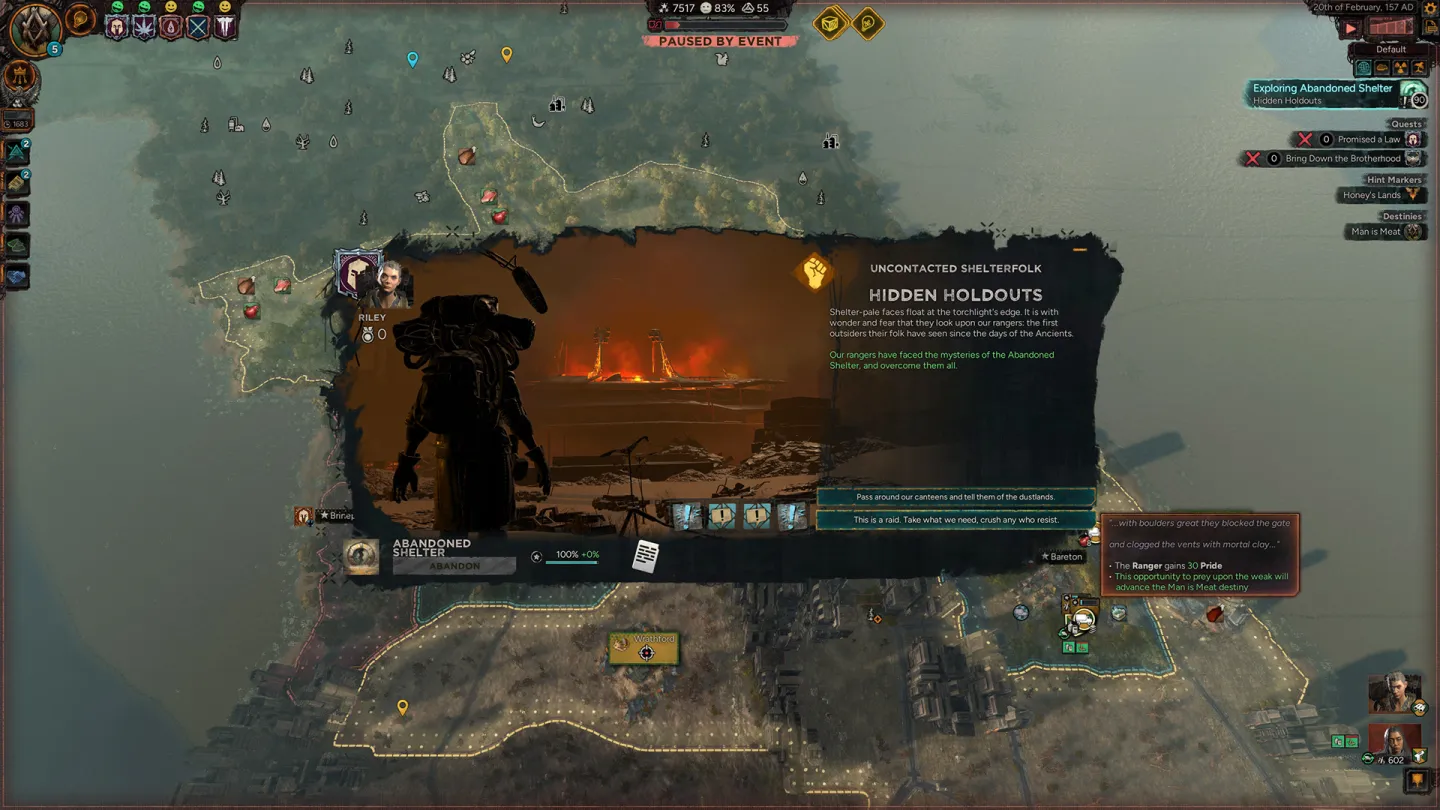
Afterworld’s announced campaign arc runs from desperate local survival to continental grand strategy. The game starts with a small band, gives that group immediate material problems, and then adds more political and strategic responsibility as it becomes a tribe and a larger state.
This is an official-system overview, not a hands-on walkthrough. No public build was available during this review, so the sequence below explains Paradox’s stated design without inventing controls, timings, or a best opening.
1. Begin with an Origin
An Origin establishes the tribe’s initial situation. Official examples include shelterfolk leaving a failing nuclear bunker and zealots searching the dustlands for their goddess. Paradox says other playable Origins exist, but it has not published a complete roster or modifier table.
The beginning is intentionally small. Developer commentary says the player starts with a compact background and makes most defining decisions during the campaign rather than fully designing a finished civilization before play begins.
2. Solve immediate survival problems
Food, water, fuel, and shelter are the first named needs. Exploration takes place in a world with scarce resources, hazardous terrain, hostile wildlife, rival groups, and dangerous remnants of advanced technology.
The official design principle is adaptation. A plan can be disrupted by the world, and the tribe must respond to what it finds. Paradox has not yet published production rates, gathering controls, storage limits, or failure thresholds, so this is a relationship between systems rather than an optimization guide.
3. Discover the world and new possibilities
Exploration does more than uncover territory. It can expose resources, tribes, threats, old history, and discoveries that affect progression. The dynamic Ideas Tree is tied to those encounters: the official examples are learning irrigation after finding a river and discovering organized religion after meeting another tribe.
Developer Diary #2 adds that each campaign begins from recognizable pre-Fall geography altered by a semi-random apocalypse. The strategic context can therefore vary even when the underlying place is familiar. See the world-map guide for that fixed-versus-procedural boundary.
4. Establish settlements and movement networks
Survival expands into a network problem. Official material names settlements, convoys, and supply lines as tools for exploiting newly found wealth. A group may also migrate when the land can no longer support it, and the first settlement does not have to remain the capital.
This makes location and movement part of the announced strategy, but exact route capacity, transport speed, building chains, and settlement limits remain unknown. The settlements and resources guide keeps those unavailable values separate from confirmed concepts.
5. Deal with other people
Other groups can be trading partners, additions to the growing nation, rivals, or military targets. Paradox explicitly mentions negotiation, absorbing wandering tribes, raiding, alliances, and wars of conquest. The game is framed around both cooperation and conflict rather than expansion through one fixed method.
At the same time, a larger population creates internal questions. Players draft laws, decide how scarce goods are allocated, determine who has a voice in leadership, and respond to changing demands and crises. The laws and society guide explains only the choices currently supported by official material.
6. Confront larger powers
The scale eventually reaches competing empires and the immortal leaders known as Ancients. The September 4 official interview calls these figures ancient tyrants who have divided the continent among themselves. It says players may try to defeat them from within or become strong enough to challenge them from outside, but it does not define the underlying mechanics.
Official sources also confirm single-player, competitive multiplayer, and co-op. Steam lists Workshop support, while the interview says the team intends deep modding support and tools. Rules, player limits, and tool details remain unannounced.
Evidence boundary
Confirmed design concepts are not the same as verified moment-to-moment play. Controls, pacing, combat resolution, diplomacy rules, numerical balance, victory conditions, campaign length, and optimal strategy remain unavailable. Those subjects require more first-party documentation or reproducible access to the game.
Last verified: September 6, 2026.
Quick answers
Frequently asked questions
Is Afterworld primarily a survival game or a grand strategy game?
Paradox describes it as a grand strategy game that begins with small-scale survival and grows into settlement management, politics, diplomacy, conflict, and continental expansion.
Does Afterworld have multiplayer?
Yes. Official sources confirm competitive multiplayer and co-op, while detailed rules and player limits remain unannounced.
Sources & verification
How this page was checked
Last verified
- 01paradoxinteractive.comdeveloper
Official announcement supports the game premise, developer framing, and major announced systems.
View source - 02steamcommunity.comdeveloper
Official Steam Community surface exposes Developer Diary #1 and #2, including the design pillars and procedural-world model.
View source - 03youtube.comdeveloper
Official interview supports the gradual survival-to-grand-strategy sequence, multiplayer, modding, and Ancients claims.
View source