Player guide
Afterworld Settlements and Resources
Learn the confirmed role of food, water, fuel, shelter, settlements, convoys, supply lines, and migration in Afterworld.
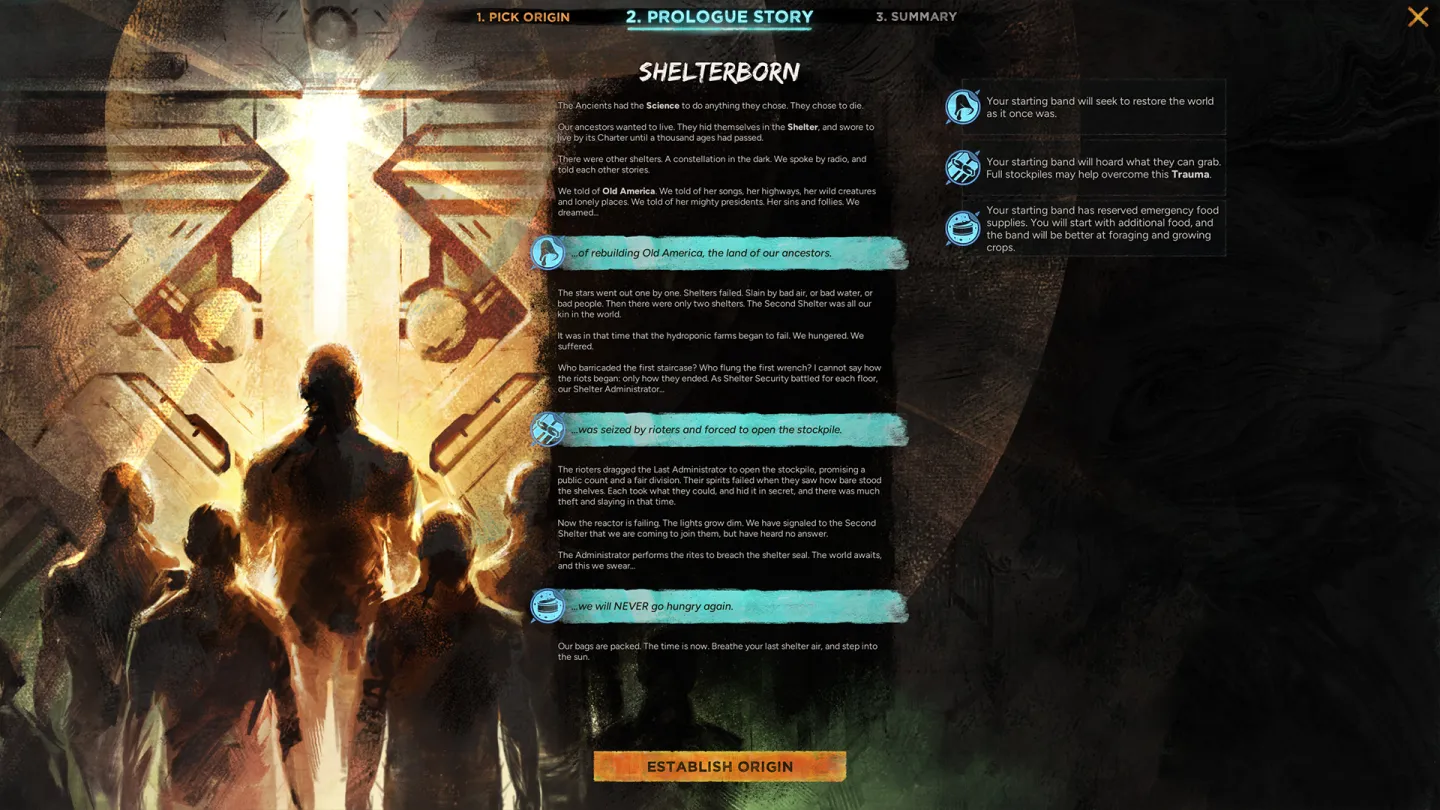
Afterworld begins with survival needs but is designed to grow into a grand strategy game. Settlements and resource movement connect those two scales: a small band must secure the basics, while an expanding state must decide where people live and how distant wealth reaches them.
The confirmed survival needs
Official descriptions repeatedly name food, water, fuel, and shelter. The announcement press release also describes scavenging food, water, and shelter as the first challenge before the tribe rediscovers basic methods of civilization.
Those needs are connected to place. Developer Diary #2 explains that the simulated apocalypse can leave different environmental scars in different campaigns. A nuclear strike may reduce drinkable water while leaving recoverable parts for groups equipped to face radiation. Other regions may be shaped by unusual disasters, and safe fertile land is described as exceptionally valuable.
This supports a clear player-facing conclusion: the world determines which survival problems a group faces. It does not yet support exact yields, depletion rates, gathering ranges, or resource conversions.
From camp to settlement network
Paradox says players build their first settlements in the wasteland and eventually expand across America. The first settlement does not necessarily remain the capital. That wording presents settlement choice as part of a developing state, not just a permanent starting base.
The official site also names convoys and supply lines as ways to exploit newly discovered wealth. These systems imply that finding a resource and making it useful are separate problems: people and goods must be connected across the map. The September 4 interview further frames the early game around finding food and water before borders, laws, and empire-building become larger concerns.
No reviewed source provides a route-building interface, convoy capacity, travel time, maintenance cost, or settlement limit. Those remain unavailable rather than estimated.
Migration is an announced option
If the land runs dry, Paradox says the player can migrate the entire band. Developer Diary #2 also describes societies that move from place to place while grazing herds and scavenging. This makes movement a supported part of the setting and game premise, not merely background lore.
The sources do not yet explain when migration becomes available, what must be moved, what is abandoned, or how established settlements are affected. The practical decision rules will need game access or a dedicated first-party systems diary.
People are part of the resource problem
Other tribes are described as both a resource and a threat. The player can negotiate trades, absorb wandering groups, or take what is needed by force. Growth therefore includes people, relationships, and security as well as materials.
Scarcity also becomes political. The laws and society guide covers the confirmed questions around allocating goods and deciding who has a voice. A shortage can become a famine, while a political mistake can fracture the nation, but the numerical rules behind those outcomes have not been published.
Evidence boundary
This guide maps the confirmed relationship among resources, settlements, convoys, supply lines, migration, and population. It does not provide recipes, building chains, capacities, costs, placement bonuses, production rates, or an optimal layout. Those details remain unavailable.
Last verified: September 6, 2026.
Sources & verification
How this page was checked
Last verified
- 01paradoxinteractive.comdeveloper
Official announcement supports the game premise, developer framing, and major announced systems.
View source - 02paradoxinteractive.comofficial
Official game site supports food, water, fuel, settlements, convoys, supply lines, migration, trade, absorption, and raiding.
View source - 03forum.paradoxplaza.comdeveloper
Official Developer Diary #2 supports environmental scarcity, fertile-land value, migration, and procedural regional conditions.
View source